Fire safety
Are extension leads a fire risk? What stops them - and what doesn't.
Overloaded or damaged leads start fires every winter.
The shell is the last line of defence - here is how ours is tested.
Quick answer.
Yes - an overloaded, damaged or poorly made extension lead can start a fire. What limits the damage is the housing: a flame-retardant shell that self-extinguishes instead of feeding the flames. Every PARTH shell passes a 750°C glow-wire test before it is allowed into production.
How a lead actually catches fire
Extension leads rarely burn on their own. The sequence is almost always the same: too many high-power appliances on one lead, or a loose/damaged connection, heats the conductors and sockets hour after hour. Eventually the plastic around the hottest point softens, discolours - and if that plastic feeds the fire instead of resisting it, the lead becomes the accelerant.
Winter is peak season: Christmas lights, heaters, electric blankets and party kitchens all plug in at once. The load limits are in our overloading guide - but even a perfectly used lead needs a shell that refuses to burn.
What “flame-retardant” actually means
A flame-retardant shell is made of a compound that does not sustain combustion. Exposed to a flame or a glowing hot element, it may deform and discolour - but it self-extinguishes within seconds of the source being removed, and it does not drip burning material. Cheap shells made of generic plastic do the opposite: they ignite, spread and drip.
The industry benchmark for this behaviour is the glow-wire test (IEC 60695-2-10): a heated element at up to 750°C - the temperature of a glowing electrical connection - is pressed against the housing for a fixed time. The shell must not ignite, or must extinguish itself within seconds, and cannot be weakened structurally.
We press 750°C against every shell we make
This is the glow-wire test on a PARTH housing in our lab - the element you see glowing red is at 750°C, pressed against the shell exactly where a hot connection would touch it in real life:
Every batch, before it ships.
750°C glow-wire element
the temperature of a glowing connection
Pressed where hot spots form
on the housing, in real failures
Self-extinguishes in seconds
no sustained combustion, no drips
Every material batch
tested before production is approved
Glow-wire test (IEC 60695-2-10) in the PARTH lab: the shell must self-extinguish - production is only approved once it does.
Every shell material batch is tested this way before production is approved. If the housing sustains combustion or drips flaming material, the material is rejected - not the sample.
How to pick a fire-safe lead
Three things to check before you buy:
1. The material, not just the logo. A listing that says flame-retardant, V-0 rated or glow-wire tested means the shell was engineered against fire - generic plastic listings mean nothing.
2. A real fuse. A BS 1363 13A fused plug is what stops an overload before the shell is ever tested.
3. A maker that tests. Certificates can be photocopied; test labs and published internals cannot.
The difference between a certified lead and a well-built one is exactly the difference in cheap vs expensive extension leads.
Flame-retardant PARTH leads
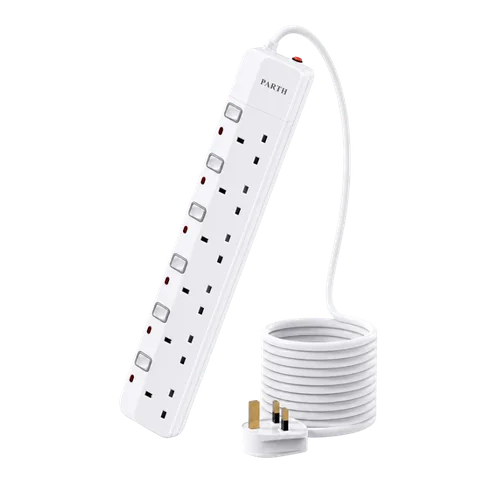
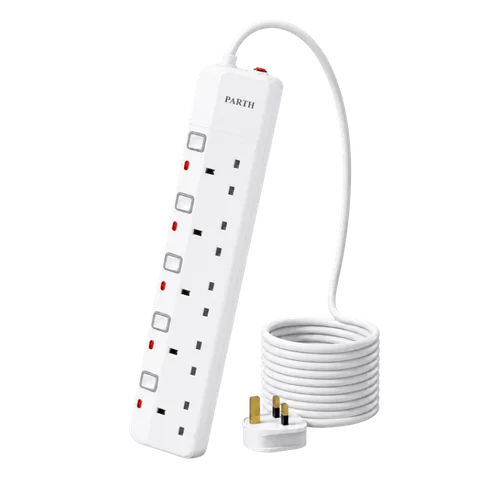

Certified fire safety, not just claims
- Our shells pass the 750°C glow-wire test on parts holding live components — no flame, no sustained glowing.
- Cable: 1.25mm² pure copper, H05VV-F, BSi-certified (VC 720445) — not the 0.75mm² found in budget leads.
- Dielectric: 3750V for 60 seconds, no breakdown, no flashover.
Common questions.
Yes - most commonly when it is overloaded (too many high-power appliances), damaged, or built with thin conductors and a shell that ignites instead of self-extinguishing. Winter is peak season.
The housing compound does not sustain combustion: exposed to flame or a glowing element it may discolour, but it self-extinguishes within seconds and does not drip burning material.
An IEC standard test (60695-2-10) where an element heated to up to 750°C is pressed against the housing for a fixed time. The shell must not ignite - or must self-extinguish within seconds - to pass.
Check three things: a BS 1363 fused plug, a shell described as flame-retardant or glow-wire tested, and a maker that shows its internals and tests. If the plug or cable ever feels hot, smells, or shows discolouration - stop using it immediately.
Keep reading
Plan the Christmas load in our Christmas party guide, stay inside the limits with how to avoid overloading extension leads, and see why the internals matter in cheap vs expensive extension leads. Compare the PARTH range.