Safety guide
How to Avoid Overloading Extension Leads at Home
Use one extension lead within its rating, check what you plug in together and keep higher-power appliances separate from everyday chargers and lamps.
Quick answer
Do not treat spare sockets as spare capacity. Add up the devices you plan to use at the same time, keep the total within the extension lead rating and never plug one extension lead into another. If a plug, cable or socket becomes hot, damaged or smells unusual, stop using it.
Socket count does not increase the safe load
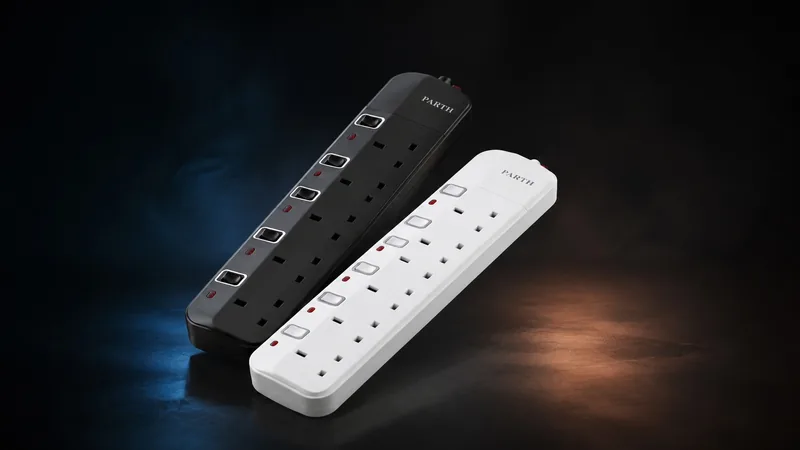
A 5-outlet or 6-outlet extension lead gives you more places to plug in devices, but it does not make the wall socket or lead more powerful. The safe limit is the rating shown on the lead and plug, not the number of empty sockets.
Every current PARTH extension lead is rated 3250W, 250V and 13A max. Use the lead within that rating and check the appliance label or manual if you are not sure how much power a device uses.
Simple check
Before you plug things in together.
- Count only the devices you will use at the same time.
- Check the extension lead rating and each device rating.
- Keep higher-power appliances away from crowded extension leads.
- Plug the extension lead directly into a fixed wall socket.
- Do not connect one extension lead into another.
Know the difference between low-power and high-power items
A phone charger, router or desk lamp usually uses much less power than a kettle, toaster, portable heater or microwave. The risk comes when several higher-power appliances are used from the same lead at the same time.
This table is a practical guide, not a substitute for the rating label. Always check the appliance and extension lead rating before use.
Do not daisy-chain extension leads
Daisy-chaining means plugging one extension lead into another. It can make the total load harder to judge and is not recommended by UK safety guidance. Use one extension lead plugged directly into the fixed wall socket, or have additional fixed sockets installed by a qualified person if a room regularly needs more power points.
Keep the lead visible and cool
Place the cable where it is not trapped under furniture, covered by rugs or run across a doorway. Keep it dry and away from heat. A lead that is hidden or covered is harder to notice if it becomes warm or damaged.
- Do not use a lead with cracked casing, damaged cable or loose sockets.
- Do not tape over damaged cable or plug parts.
- Stop using the lead if you see scorch marks, smell burning or feel unusual heat.

Keep simple areas simple
For a bedside table or small desk, a 2-socket lead can keep everyday charging tidy without adding unnecessary outlets.

Group lower-power desk devices
A home office lead is best used for typical desk electronics such as a laptop charger, monitor, router, lamp and phone charger within the lead rating.

Plan before adding more devices
For TV corners or shared spaces, choose socket count and cable length for the layout, then keep the total load within the lead rating.
Useful UK safety sources
For independent safety guidance, Electrical Safety First explains socket overloading and extension lead use, while London Fire Brigade gives practical advice on cables, fuses and leads in the home.
Next step: choose the right lead for the room
If you are still choosing between socket count and cable length, start with the room layout and the devices you plan to use together.
Questions
Common questions.
How do I know if an extension lead is overloaded?
Check the extension lead rating and the devices used at the same time. Stop using the lead if it becomes unusually hot, smells of burning, shows scorch marks or has damaged parts.
Can I plug one extension lead into another?
No. Plug one extension lead directly into a fixed wall socket and do not connect extension leads together.
Can I use a kettle or heater on an extension lead?
Higher-power appliances need extra care. Check the appliance instructions and lead rating first, and do not run several high-power appliances from the same extension lead at the same time.
Does a 6-outlet lead have more capacity than a 2-socket lead?
No. More outlets give more plug positions, but the safe load still depends on the lead rating and the devices used together.