Protection explained
Surge vs overload: what is actually protecting your devices?
They sound similar — and protect against completely different threats.
Overload: too much current drawn inside your room.
Surge: voltage spikes arriving from outside the house.
Kettle + heater + washer through one lead heats the cable.
Lightning or switching kills laptops, routers and TVs.
Surge protection plus overload cut-off on every lead.
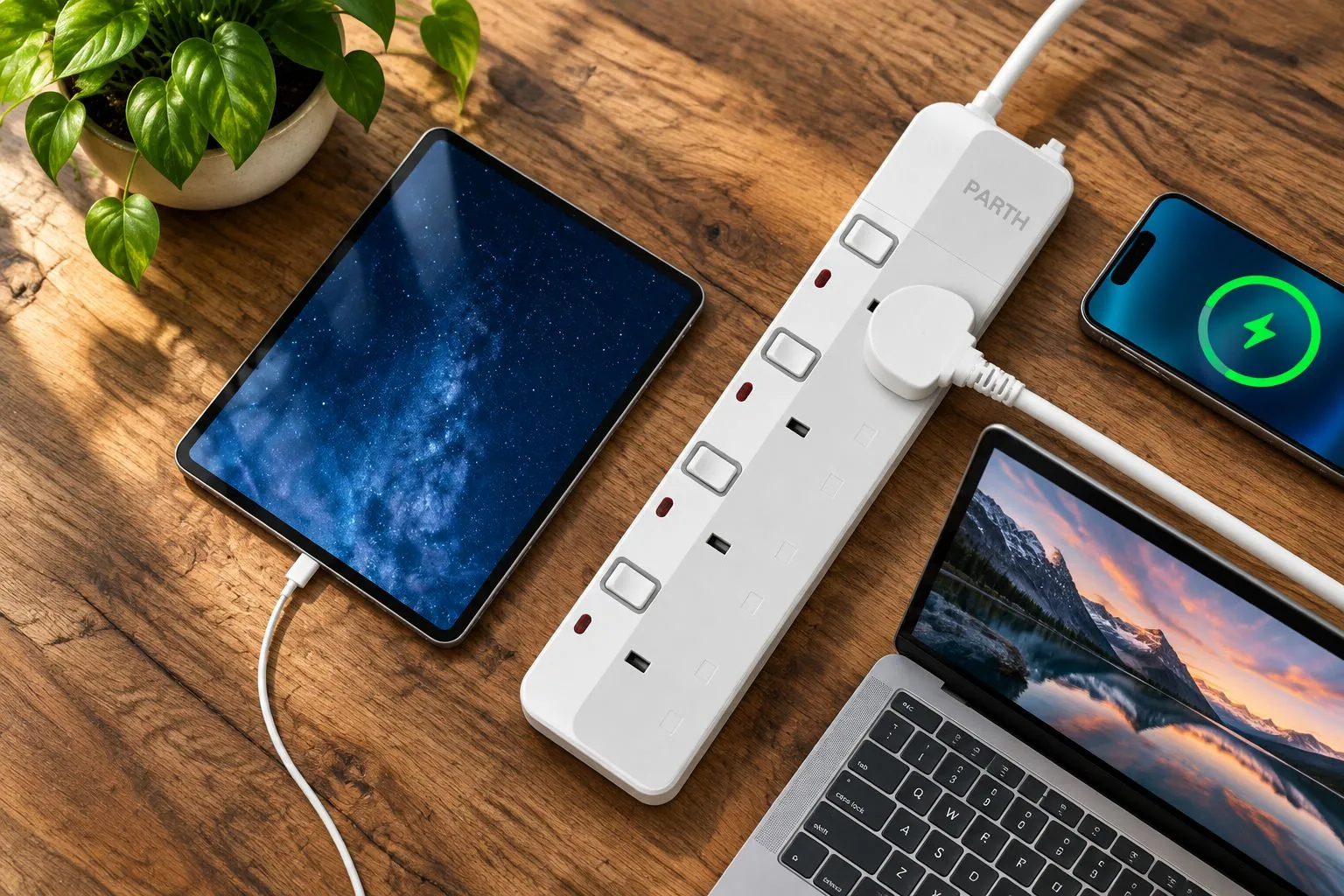
Two different enemies
An overload comes from inside your room: the kettle, the heater and the washing machine all drawing through one lead until the cable carries more current than it was built for. The cable heats, the insulation ages, and in the worst case it fails. A surge comes from outside the house: a lightning strike near the supply or the grid reconnecting after a cut. For a fraction of a second the voltage jumps far above 230V - most appliances shrug it off, but laptops, routers and TVs can be killed outright.
What the overload protector actually does
Inside a PARTH lead sits a thermal overload protector in the live path. When total current draw exceeds the safe rating for the cable, it trips and cuts power - before heat can build up in the wiring. Resetting is a press of the button. You can see the component opened up in what's inside an extension lead.

A simple rule for home offices
- Laptop and monitor
- Router and phone chargers
- Desk lamp and speakers
- Kettle (3kW, 13A alone)
- Heater or tumble dryer
- Anything else near 3250W
Protected leads for your devices
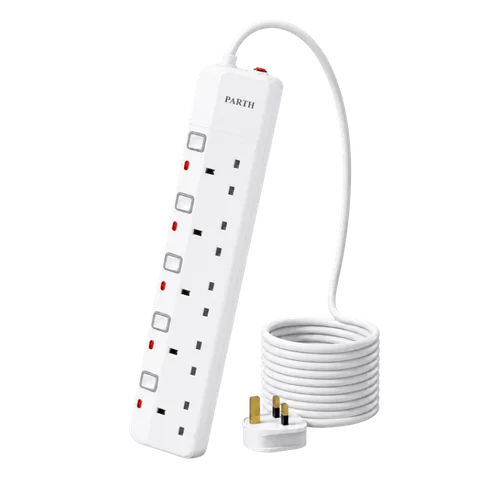
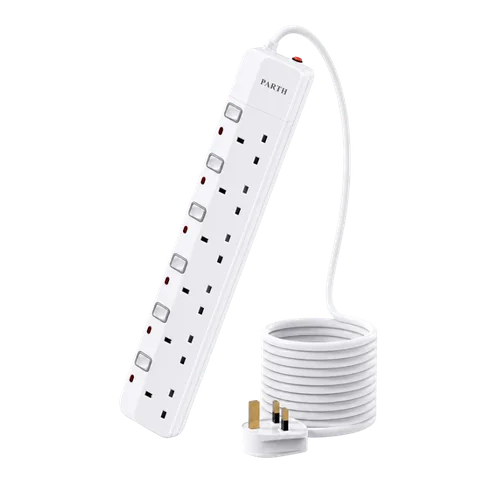

Our surge protection, independently verified
- S-series surge models pair a VDE-listed varistor with a 125°C thermal cut-off (IEC 61051 / IEC 60691) — so the varistor can never cook quietly, exactly as the standard demands.
- Overloads are handled by a TUV-listed override breaker to EN 60934. Spikes go to the varistor; sustained overloads trip the breaker.
- All of it verified in BS 1363-2:2016 report 22050477HKG-001 (Intertek, May 2023) — every clause passed.
Common questions.
What is the difference between a surge protector and a regular extension lead?
A regular lead only extends your sockets. A surge-protected lead adds a component that absorbs voltage spikes from the mains. PARTH leads add overload cut-off as well, protecting the cable from too much current.
Do I need surge protection if I have a fuse?
Yes. The 13A BS 1362 fuse responds to sustained overcurrent - it does nothing about a millisecond voltage spike. They cover different failure modes, which is why PARTH leads carry both.
Can I plug a kettle into a protected extension lead?
Best practice is no. A 3kW kettle draws around 13A on its own. Keep kettles and heaters on wall sockets and use the protected lead for electronics.
Keep reading
See every protection layer in what's inside an extension lead or the plug side of the story in what makes a safe UK plug? Compare the PARTH range.