Inside the product
What’s Inside an Extension Lead? The 5 Parts That Do All the Safety Work.
A switched UK extension lead looks simple from outside.
Inside, five parts decide whether it is safe — and cheap leads skip or cheapen every one of them.
Quick answer.
The five parts are: the flame-retardant housing, the shutter system, the individual switches, the copper busbar and terminals, and the protection modules (circuit breaker, surge protection, USB). Every one of them is tested to BS 1363-2:2016 — and every one of them is a place where a cheap lead saves money you can’t see.
Part 1 — The flame-retardant housing
The shell is the last line of defence. In our Intertek type test, housings were exposed to a 750°C glow-wire on parts holding live components — the temperature of a glowing electrical connection — with no flame and no sustained glowing. The same shells survived 70°C for 7 days of heat ageing and a 75°C ball-pressure test with impressions well under the 2mm limit.
Generic plastic shells ignite, spread and drip. Ours self-extinguish in seconds — verified, not claimed.
Part 2 — The shutter system
BS 1363 requires shuttered socket apertures so that children poking single objects into live holes touch nothing dangerous. PARTH shutters are spring-loaded plastic gates that only retract when a proper earth pin opens the way first — the same mechanism verified in our type test, where a 1mm rigid pin introduced through the earth aperture touched no live parts.
Part 3 — Individual switches
Each socket on a PARTH lead has its own switch — so appliances you are not using are genuinely disconnected instead of idling live. The switches were tested at 16.25A 275V~ breaking capacity, then put through repeated slow-operate arcing cycles with no damage. Contact resistance stayed low enough that voltage drop across every switched pole measured far below the 75mV limit.
They also have a positive on/off action: the switch cannot come to rest in a half-made contact position where arcing would linger.
Part 4 — The busbar and terminals
Current travels through a one-piece brass / phosphor-bronze busbar — chemically tested in our report with no cracks and no rust. The cable is 1.25mm² pure copper, H05VV-F, itself BSi-certified (VC 720445), anchored so firmly that after 10,000 bend cycles at 2kg load, 0 out of 40 strands broke. Cord grip, terminal screws, soldered joints — all individually verified.
Part 5 — The protection modules
Depending on the model, a PARTH lead carries up to three independently verified modules:
A TUV-listed override breaker (EN 60934) that trips on sustained overloads — the red button you actually press.
VDE-listed surge protection: a varistor with a 125°C thermal cut-off (IEC 61051 / IEC 60691), so it can never fail quietly.
A certified USB charging module: 5V 2.1A to IEC 62368-1 and IEC 62680-1, with overcurrent protection on the primary side.
Every part, one report
All of the above comes from a single Intertek type test to BS 1363-2:2016 — report 22050477HKG-001, issued May 2023, 45 pages, every clause passed. The samples tested are identical to the products we ship.
Leads built this way
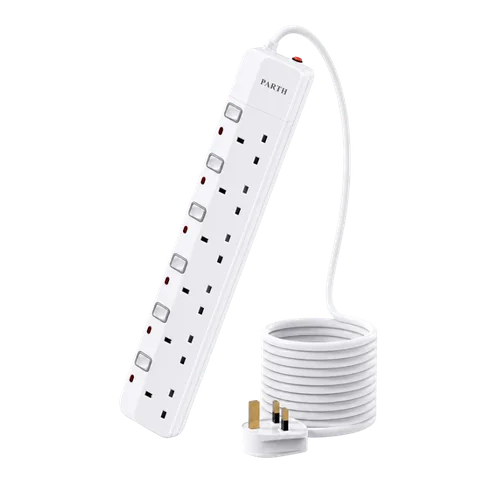

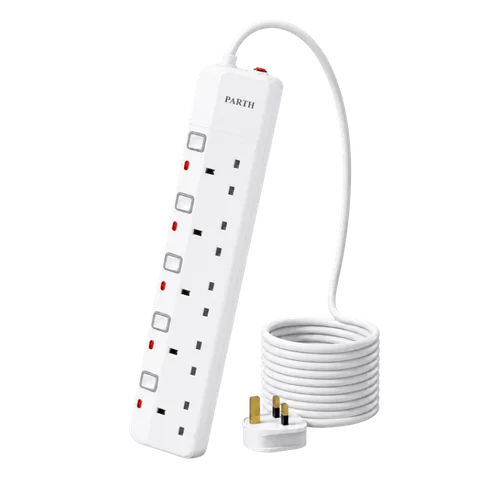
Certified inside, not just outside
- Full BS 1363-2:2016 type test — Intertek report 22050477HKG-001, May 2023, every clause passed.
- Components independently certified: ASTA plug (Lic. 1457), BSi cable (VC 720445), TUV breaker, VDE surge parts.
- UKCA & CE electromagnetic-compliance verifications cover the whole range.
Common questions.
Five: a flame-retardant housing, shuttered socket apertures, individual switches, a copper busbar with terminals, and — on protected models — breaker, surge and USB modules. Each is separately tested to BS 1363-2:2016.
They let you genuinely disconnect the sockets you are not using, instead of leaving appliances idling live. PARTH switches are rated to break the full 13A load and were arcing-tested as part of the type test.
Spring-loaded gates cover the live apertures and only retract when a proper earth pin opens the way — so poked-in single objects touch nothing dangerous. Required by BS 1363 and verified in our test with a 1mm rigid pin.
Yes — it is a separately certified module (IEC 62368-1 and IEC 62680-1) with overcurrent protection on the primary side, double insulation from the mains circuit, and its own type testing.
Keep reading
See what the housing is made of in our fire-safety guide, how the two protection modules differ in surge vs overload protection, and what the plug standard actually requires in BS 1363 plugs explained. Compare the PARTH range.