Buying guide
Extension Lead vs Power Strip: What Is the Difference?
In UK shops the two names are used almost interchangeably — but there is a real difference hiding in the cable. Here is what each term means, which one your room actually needs, and the safety rules both share.
Quick answer
A power strip is the American name for a block of sockets; an extension lead is the UK term for the same idea with a length of cable between the plug and the sockets. If the product has a metre or more of cable, it is an extension lead — and that cable is what lets you bring power to the middle of a room instead of living next to the wall.
The same product, two names
Shoppers in the UK search "extension lead", "extension cord" and "power strip" and expect to find the same shelf. Around the world the wording shifts, but the product stays recognisable:
| Term | Where you hear it | What it means |
|---|---|---|
| Extension lead | UK, everyday | Sockets on a cable, plugged into the wall |
| Power strip | US, and online generally | The socket block itself, any cable length |
| Extension cord / extension cable | US & UK | Often a single socket on a long cable, or used loosely for leads |
| Trailing socket / trailing lead | UK, trade & safety guidance | A lead that trails across the floor — handle with care |
So the name is not the decision. The decision is what sits between the plug and the sockets: the cable.
What actually differs: the cable
| Long-cable extension lead | Short-cable or plug-in strip | |
|---|---|---|
| Cable length | 2 to 10 metres | 0 to 0.5 metres, or plugs straight into the wall |
| Reaches past the wall | Yes — desks, sofas, beds in the middle of the room | No — devices must sit beside the socket |
| Best for | Room layouts where the socket is not where the devices are | Tight spots: behind a TV bracket, a bedside table hard against the wall |
| Watch out for | Routing — keep cables along skirting, never under rugs | Force on the plug — a heavy strip hanging from a wall socket strains the contact |
Every PARTH lead is the long-cable kind, from 2 metres to 10 metres, because that is what UK rooms usually ask for: the wall socket is in the corner, and the desk, bed or TV is not.
Pick by room, not by name
Measure the route from your wall socket to where the devices will sit — along the skirting board, not in a straight line — and add about a metre of slack. Then match the length:
- Desk next to the socket: a 2 metre lead keeps things tidy with cable to spare.
- Bedside or sofa in mid-room: 3 metres usually routes neatly around the room.
- Loft office, garage or long living room: 5 to 10 metres reaches without joining two leads together.
The safety rules are identical
Whatever the product is called, UK safety guidance is the same. Check the rating before you buy, and never plug one multi-socket product into another — daisy-chaining can overload the wall socket even when every individual product is within its own rating.
- Look for a 13A fused UK Type G plug and a 3250W maximum load.
- Keep the total of everything running together within the rating.
- Never plug a lead or strip into another lead or strip.
- Keep cables visible, dry and uncovered — no rugs, no furniture on top.
One standard, every length
From the 2-metre desk lead to the 10-metre long-reach lead, the safety specification never changes.
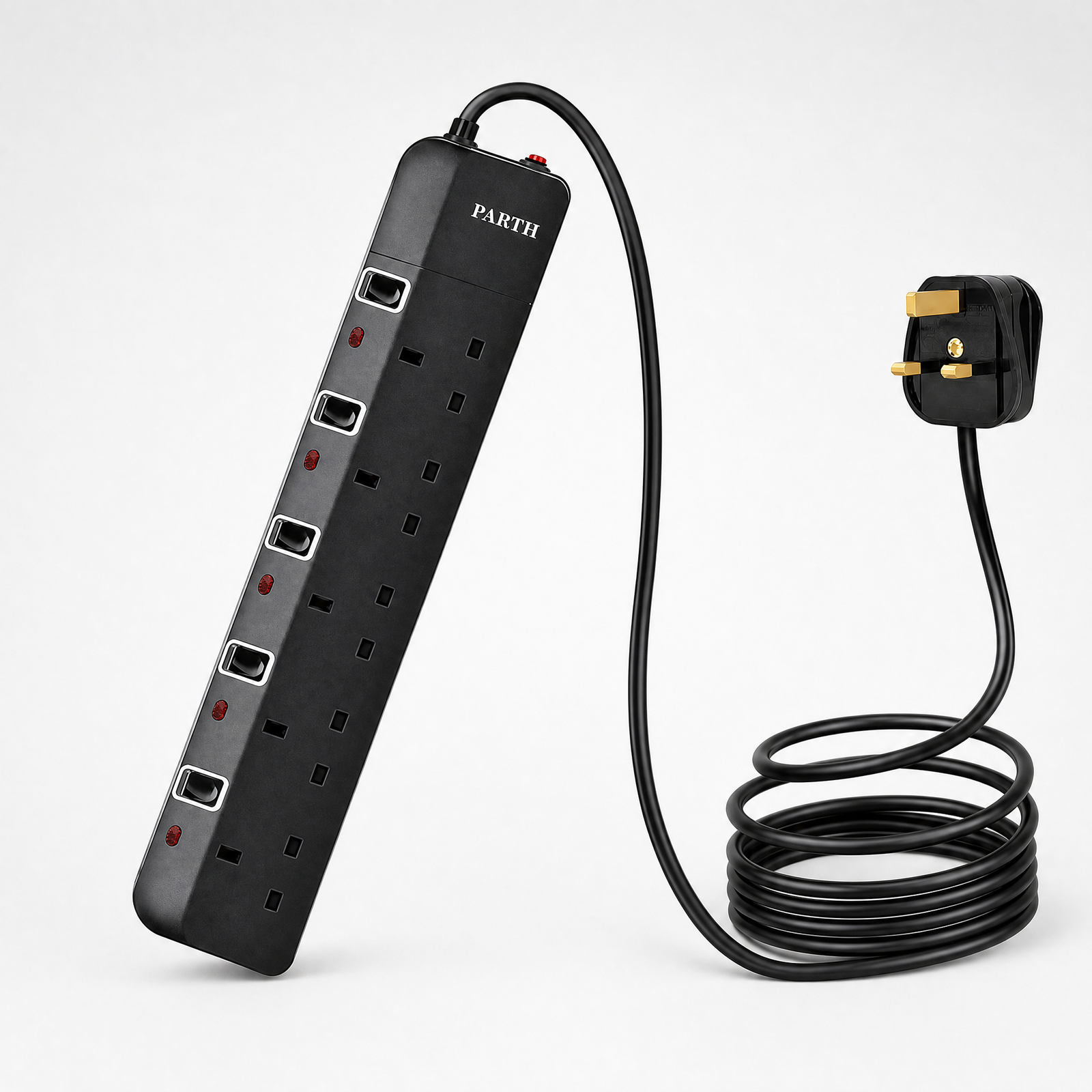

Same standard on every PARTH lead.
Whatever you plug in, four features do the quiet work:
Safety shutters
Child-resistant shutters guard every outlet, so curious fingers, dust and stray paperclips stay on the outside.
Overload protection
Misjudged the load? Overload protection cuts the power before anything gets stressed.
Individual switches
One switch per outlet — turn a single device off without unplugging, or take the whole board dark in one tap.
LED indicators
A light per switch shows which outlets are live at a glance.
Questions
Common questions.
Is a power strip the same as an extension lead?
In UK everyday speech the two names describe the same thing: a block of sockets that plugs into one wall outlet. Strictly, "power strip" is the American term for the socket block itself, while an extension lead includes a length of cable between the plug and the sockets. UK shoppers searching either term are usually shown the same products.
Which is safer, an extension lead or a power strip?
Neither type is inherently safer — what matters is the rating and how you use it. Look for a 13A fused UK Type G plug, a 3250W maximum load, and safety features such as surge protection and child-resistant shutters. Both types must be kept out of daisy-chains and used within their rated load.
Can I plug a power strip into an extension lead?
No. Plugging one multi-socket product into another (daisy-chaining) is against UK fire-safety guidance because the wall socket can be overloaded even when each individual product is within its own rating. Choose one lead with enough switched outlets for the job instead.
What length extension lead do I need?
Measure the real cable route from the wall socket to where the devices sit — along the skirting, not as the crow flies — then add about a metre of slack. A 2m lead suits desks next to a socket, 3m covers most rooms, and 5m–10m serves lofts, garages and long rooms.
Do PARTH extension leads have surge protection?
Yes. Every PARTH extension lead includes surge protection, overload protection, individually switched outlets with LED indicators, a 13A fused UK Type G plug and child-resistant safety shutters, with a 3250W rated load.